
Understand your hips.
Move with confidence.
Hip health affects how we walk, sit, stand, sleep, and enjoy everyday life. AyuHipHealth brings together clear information about hip conditions, movement, prevention, and recovery.

Hip health is part of everyday health.
Your hips help support almost every movement you make. Changes in strength, flexibility, joint health, or balance can affect simple activities such as walking, getting out of a chair, climbing stairs, or sleeping comfortably.
A better understanding of the hips can help you recognise symptoms, prepare for a consultation, and make informed choices about movement and care.

Explore hip health
Seven starting points, depending on what you're trying to understand.
Hip anatomy
How the ball-and-socket joint, cartilage, muscles, and tendons work together to support movement.
Explore topicCommon hip conditions
Plain-language explainers on osteoarthritis, bursitis, impingement, and other patterns we’re often asked about.
Explore topicUnderstanding hip pain
What hip pain can mean, common patterns people describe, and how to talk about it with a clinician.
Explore topicMobility and flexibility
Why hips stiffen up after sitting or rest, and gentle ways to support everyday range of motion.
Explore topicStrength and balance
The muscles that stabilise the hip during walking and standing, and why balance matters too.
Explore topicRecovery and rehabilitation
General guidance on movement after injury or surgery, and why an individual plan matters.
Explore topicWhen to seek medical advice
Signs that a hip symptom is worth a proper clinical assessment rather than waiting it out.
Explore topicCommon hip conditions
Short, cautious explainers on patterns we're often asked about. These describe general possibilities, not a diagnosis.
Hip Osteoarthritis
A condition in which the tissues within the hip joint change over time. It may cause pain, stiffness, and difficulty with everyday movement.
Learn more →Hip Bursitis
Irritation of one of the small, fluid-filled sacs that help reduce friction near the hip. Pain may be more noticeable when lying on the affected side.
Learn more →Hip Impingement (Femoroacetabular Impingement)
A pattern where the ball and socket of the hip don't glide past each other quite as smoothly as expected, which can cause pinching pain with certain movements.
Learn more →Hip Tendon and Muscle Injuries
Strains and overuse injuries affecting the muscles and tendons around the hip, from a mild niggle to a more significant tear.
Learn more →Hip Labral Injuries
Damage to the ring of cartilage that lines the rim of the hip socket, which can cause catching, clicking, or groin pain.
Learn more →Hip Fractures
A break in the upper part of the thigh bone, most often linked to a fall, that needs prompt medical attention — general education on what to know.
Learn more →Hip Stiffness
Understanding stiffness in the hip — common causes, how it differs from pain, and when it's worth a clinical opinion.
Learn more →Persistent or severe symptoms should be assessed by a qualified healthcare professional — this page is general education, not a diagnosis.
A closer look at the hip joint
The hip is a ball-and-socket joint designed to provide both stability and a wide range of movement. Several bones, muscles, tendons, and other tissues work together to help you move. Choose a part below to explore it.
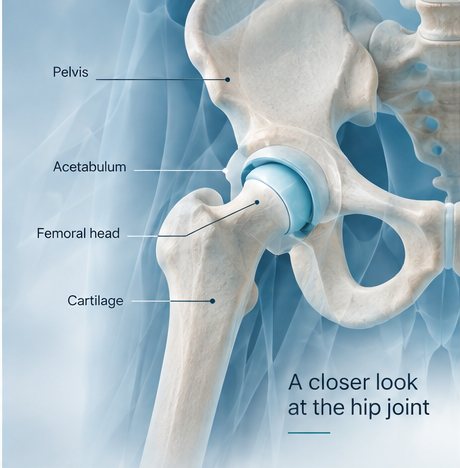
Pelvis
The pelvis is the large, sturdy bone that forms the base of the spine and the socket side of the hip joint. It supports your body weight when you sit, stand, and walk.
Femoral head
The rounded top of the thigh bone (femur). It sits inside the pelvis and rotates within it, which is what gives the hip such a wide range of movement.
Acetabulum
The cup-shaped socket in the pelvis that the femoral head fits into. Together they form the "ball-and-socket" that makes the hip joint unusually stable.
Cartilage
A smooth, slippery layer covering the femoral head and the socket. It lets the joint glide with very little friction and helps absorb load during movement.
Muscles
Large muscle groups — including the glutes and hip flexors — surround the joint. They move the hip and also help keep it stable during everyday activity.
Tendons
Tough, fibrous tissue that connects muscle to bone. Tendons transmit the force muscles generate into movement at the joint.
Small movements can support everyday mobility.
A few areas worth understanding, whether you're just getting started or building back up.
Gentle range of motion
Explore →Hip flexibility
Explore →Strength and stability
Explore →Balance
Explore →Posture and movement habits
Explore →Returning to activity after injury
Explore →Please note. Movement recommendations should be adapted to your symptoms, health history, and professional guidance. Stop if an exercise causes pain or discomfort.
Know when it's time to ask for help.
A professional assessment may be appropriate when someone has:
- Persistent or worsening hip pain
- Pain that affects your sleep or daily activities
- Difficulty walking or bearing weight
- Reduced movement that isn’t improving
- Pain following a fall or injury
- Sudden, severe pain
- Symptoms that continue despite rest or simple self-care
See a doctor now if you have:
- Sudden severe pain
- Inability to bear weight
- Fever with joint pain
- Numbness
- Loss of bladder or bowel control
- Recent trauma
Educational resources
All resources →Understanding Hip Pain
Why does my hip hurt when I walk? A plain-language look at common patterns of hip pain and what they can mean.
Hip Stiffness
Understanding stiffness in the hip — common causes, how it differs from pain, and when it's worth a clinical opinion.
Hip Anatomy Explained
A closer look at the bones, cartilage, muscles, and tendons that make up the hip joint, and how they work together.
When Hip Pain Should Not Be Ignored
Signs that hip pain is worth a proper clinical assessment, including symptoms that need urgent attention.
About AyuHipHealth
AyuHipHealth exists to make hip health information easier to understand. The goal is to help people learn about common hip concerns, understand available care pathways, and approach healthcare conversations with better questions.
More about AyuHipHealth →Start with a better understanding of your hip health.
Explore clear information about hip conditions, movement, and the questions people often have when hip symptoms affect daily life.
Explore Hip Health