
Hip Anatomy Explained
A closer look at the bones, cartilage, muscles, and tendons that make up the hip joint, and how they work together.
See a doctor now if you have:
- Sudden severe pain
- Inability to bear weight
- Fever with joint pain
- Numbness
- Loss of bladder or bowel control
- Recent trauma
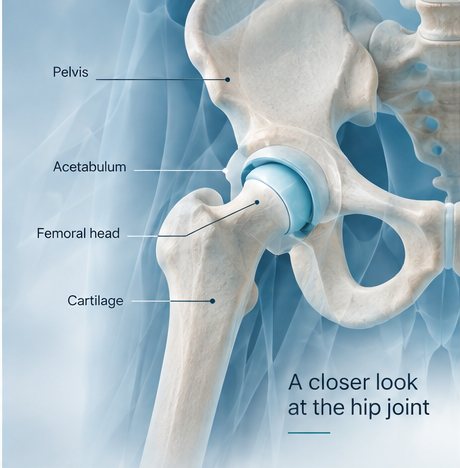
The hip is a ball-and-socket joint — one of the few in the body — which is part of why it can move in so many directions while still bearing your full body weight. Understanding its basic parts can make it easier to follow what a clinician is describing during an assessment.
The ball-and-socket joint
The rounded top of the thigh bone (the femoral head) sits inside a cup-shaped socket in the pelvis (the acetabulum). This arrangement gives the hip both a wide range of motion and a good deal of built-in stability, compared with a simpler hinge joint like the knee.
Cartilage and the labrum
A layer of smooth cartilage covers the femoral head and the socket, letting the joint glide with very little friction. A ring of tougher cartilage called the labrum runs around the rim of the socket, helping deepen it and keep the joint seated properly.
Muscles and tendons
Large muscle groups — including the glutes, hip flexors, and deep rotators — surround the joint. Tendons connect these muscles to bone, transmitting the force that lets you walk, climb stairs, and change direction. Because so many muscles cross the hip, strength and flexibility in this area affect movement well beyond the joint itself.
Why this matters
Most everyday hip symptoms trace back to one or more of these structures — the joint surfaces, the surrounding soft tissue, or how well the muscles are working together. Our interactive hip diagram on the homepage lets you explore each part individually.
One thing to do today
Pick one thing from this page and try it today — small and consistent beats occasional and intense.
Sources
- Placeholder — full citation pending clinical review — To be replaced with a peer-reviewed source before this page leaves draft status.
Related reading
Hip Bursitis
Irritation of one of the small, fluid-filled sacs that help reduce friction near the hip. Pain may be more noticeable when lying on the affected side.
Hip Fractures
A break in the upper part of the thigh bone, most often linked to a fall, that needs prompt medical attention — general education on what to know.
Hip Impingement (Femoroacetabular Impingement)
A pattern where the ball and socket of the hip don't glide past each other quite as smoothly as expected, which can cause pinching pain with certain movements.
Hip Labral Injuries
Damage to the ring of cartilage that lines the rim of the hip socket, which can cause catching, clicking, or groin pain.
Next step
Explore movement and exercise →